From paper planes that set world records to folds that went to space and folds that solve maths problems — explore the surprising world of origami, and fold some of it yourself.
The science of paper planes
There are two paper-plane world records: how far it flies, and how long it stays up. Planes built for each are thrown differently and shaped differently.
Farthest flight
Guinness record for the farthest flight by a paper aircraft
The Guinness record for the farthest flight by a paper aircraft grew from about 59 m to 98 m in forty years. The 2012 record plane, “Suzanne”, was not a pointed dart but a glider designed by John M. Collins — a sturdy glider thrown hard. The latest record, 98.43 m, was set in Shanghai in December 2025 by a team of Chinese teenagers with a single A4 sheet.
Reported rules: indoors, one A4 sheet under 100 g/m², one small piece of tape allowed
The record designs belong to their designers or are unpublished, so we only describe them here.
Guinness record for the longest time aloft by a paper aircraft
Time-aloft records are set by throwing the plane almost straight up, close to the ceiling, and letting it circle down slowly. Ken Blackburn (USA) reached 27.6 s in 1998 and Takuo Toda (Japan) 29.2 s in 2010. In February 2026 a team of Chinese teenagers raised the record to 31.2 s.
Short, stiff wings help the plane survive a hard upward throw.
Your throw sends the plane forward, and air flowing over and under the wings makes lift. Air also holds it back (drag) and weight pulls it down. Once it leaves your hand, a paper plane is a glider: it trades height for distance. How far it goes for each bit of height it loses (the glide ratio) equals lift divided by drag.
The balance point must sit ahead of where the air pushes on the wings, so the plane flies straight like an arrow — that is why the nose has extra layers.
If it dives, bend the back edges of the wings up a little; if it climbs and stalls, bend them down a little (elevator trim).
Tilting the wings up into a slight V seen from the front (dihedral) lets the plane level itself after a roll.
Long, slender wings make less drag from wingtip swirls and glide farther — but long paper wings bend easily.
For distance: throw hard and a little upward, fast and straight. For time: throw high and let it sink slowly.
Things that must open up large but travel small borrow ideas from origami: satellite solar panels, space telescopes, even medical devices that unfold inside the body.
Miura fold — opens in one pull
Miura fold crease pattern: zigzag and straight creases alternate mountain and valley
Devised by Japanese space engineer Koryo Miura, this fold is made of identical parallelograms in a zigzag. Pull two opposite corners and the whole sheet opens in one motion — and closes the same way — while every panel stays flat. Japan’s Space Flyer Unit, launched in March 1995, unfolded and refolded a Miura-folded solar array in orbit.
1980: presented as a map that opens with one pull
The Space Shuttle Endeavour brought SFU back in January 1996.
It was too big to fit in its rocket, so — in NASA’s words — it had to fold “origami-style”. Launched on 25 December 2021, it unfolded in space: the 6.5 m gold mirror of 18 segments folded its two side wings back, and the five-layer sunshield, about the size of a tennis court, was packed in zigzag folds.
Sunshield: about 21 m × 14 m
Space solar arrays and the starshade
Brigham Young University and NASA’s Jet Propulsion Laboratory worked with origami artist Robert J. Lang to turn a fold pattern called the “flasher” into a round solar array designed to stow at 2.7 m across and open to 25 m. JPL has also studied a flower-shaped starshade — a screen that blocks a star’s glare to reveal planets — whose petals wrap around the spacecraft for launch.
A 1/20-scale prototype opened to 1.25 m.
Origami inside the body
Researchers at the University of Oxford developed a stent graft folded from a single sheet of shape-memory metal foil: it travels in small and springs open when warmed. In 2016, MIT showed an origami robot that is swallowed in a capsule, unfolds in the stomach and is steered by magnets to remove a swallowed button battery.
Self-folding robots and DNA origami
In 2014, Harvard and MIT researchers reported in Science a flat sheet that folds itself into a robot in about four minutes and walks away. In 2006, Paul Rothemund at Caltech “stapled” a long DNA strand with about two hundred short strands into smiley faces about 100 nanometres across — a technique called DNA origami.
Every fold lines up points and lines — it is a geometric construction. That lets paper folding solve problems a ruler and compass cannot.
Haga’s theorem — thirds without a ruler
Fold the bottom-right corner to the middle of the top edge: the left edge is divided 2 : 1
Fold the bottom-right corner of a square up to the middle of the top edge. Where the folded bottom edge meets the left edge, it divides that edge exactly 2 : 1 — and the small triangle at the top left has sides in the ratio 3 : 4 : 5. Japanese biologist Kazuo Haga found it, and it is named after him.
Seven basic folds and angle trisection
Every construction you can make with a single fold comes down to seven ways of lining up points and lines (the Huzita–Justin axioms). Jacques Justin listed all seven in 1986; Humiaki Huzita described six and Koshiro Hatori found the seventh independently. With them you can trisect an angle and double a cube — both proved impossible with ruler and compass in 1837.
Fold and one cut
Fold a sheet the right way and a single straight cut can produce any shape made of straight lines — a star, letters, even shapes with holes. Erik Demaine, Martin Demaine and Anna Lubiw proved it in 1998–99. A puzzle of this kind already appears in a Japanese book from 1721.
How many times can you fold paper in half?
People used to say seven folds was the limit. In 2002 a US high-school student worked out a formula for the length of paper needed and folded a strip of toilet paper about 1.2 km long in half twelve times in one direction — a Guinness record. Each fold doubles the thickness, so twelve folds make 4,096 layers.
Some models flap, jump or open their mouths once finished. Others are built from many identical units slotted together.
Flapping bird, jumping frog, fortune teller
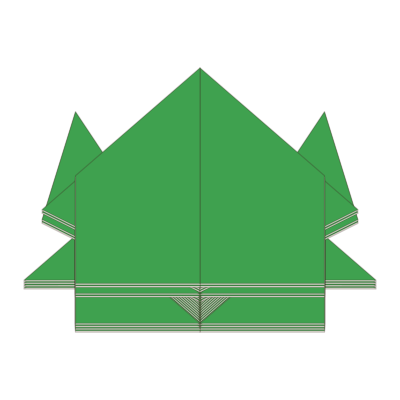
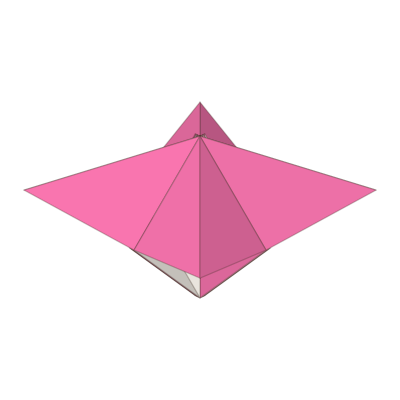
The bird that flaps when you pull its tail is an old traditional model; diagrams appeared in a French science magazine in 1885. The frog that jumps when you press its back first appears in a 1963 book, by an unknown designer. The finger-operated fortune teller seems to come from European kindergarten folding, with German diagrams from 1876.
In 1939, Princeton graduate student Arthur Stone folded the strips left over from trimming his notebook paper and found a hexagon that shows a different face each time you flex it. He worked out how it works with friends including Richard Feynman, and Martin Gardner made it famous in Scientific American in 1956.
Kusudama and modular origami
A kusudama (“medicine ball”) was originally a cloth ball of herbs and incense hung up on the fifth day of the fifth month. Today the word means a ball folded from many identical paper units. The six-unit cube made of “Sonobe units” was credited to Mitsunobu Sonobe in 1968, and artists such as Tomoko Fuse developed glue-free modular origami much further.
Origami is an old pastime — and an art where new designs and methods keep appearing.
Hiden Senbazuru Orikata (1797)
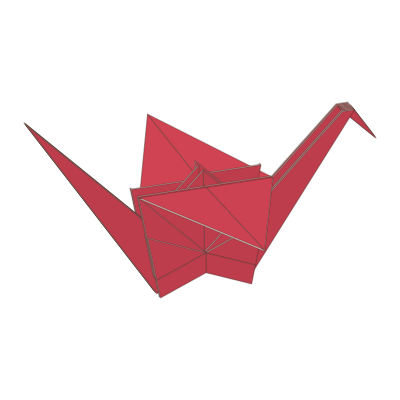
Published in Kyoto in 1797, this is known as the oldest book about recreational paper folding. It shows 49 ways to fold several cranes from one slit sheet, joined at their wingtips or beaks.
Akira Yoshizawa (1911–2005) pioneered wet-folding, dampening paper to sculpt soft curves, and in a 1954 book set out symbols — arrows and dashed lines — for showing how to fold. Adopted by Samuel Randlett and others in 1961, they became the worldwide standard for origami diagrams; the valley and mountain lines on this site follow it.
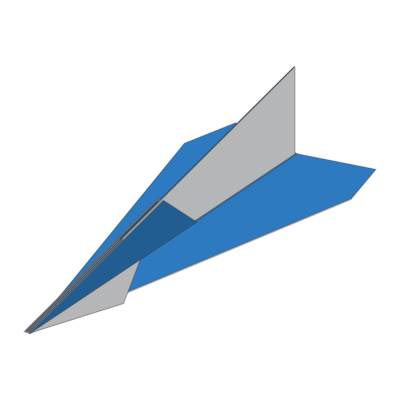 Paper airplane (dart)
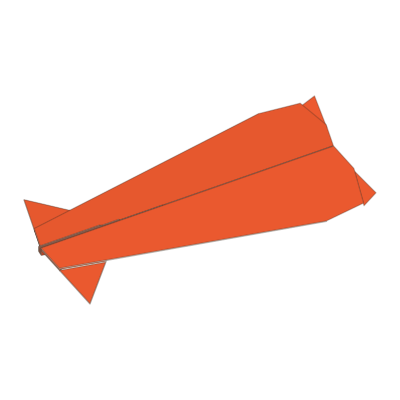 Squid plane
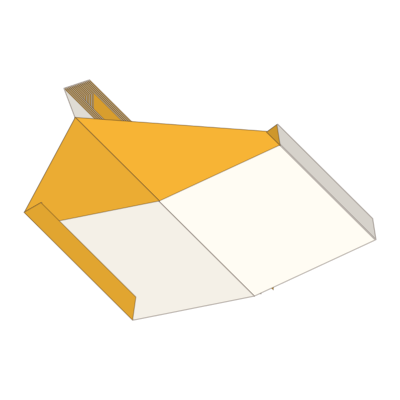 Long-flying glider
 Miura fold
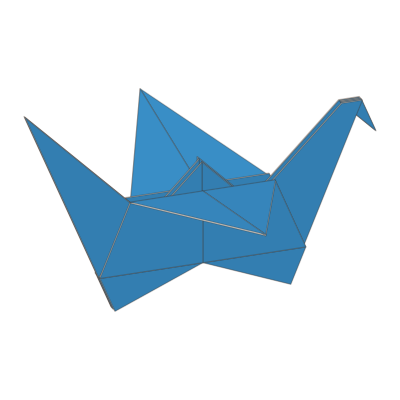 Flapping bird
 Jumping frog
 Fortune teller
 Ninja star (shuriken)
 Masu box
 Crane