Drag to rotate · Wheel / two fingers to zoom & pan
This device cannot show the 3D view. Follow the step pictures and text below instead.

1. Crease a diagonal
Coloured side up. Fold the bottom-right corner to the top-left corner and unfold.
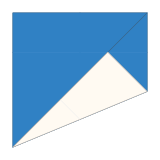
2. Bottom edge onto the diagonal
Fold the bottom edge up to lie along the diagonal, creasing from the bottom-left corner. The bottom-right corner lands on the diagonal.
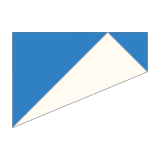
3. Fold the top behind
Mountain-fold the top strip behind along a horizontal line through the folded corner.

4. Unfold the corner
Unfold the bottom corner. You have a √2 : 1 rectangle — the shape of A4 paper.
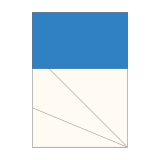
5. Fold in half
Fold in half, left edge to right edge. It is smaller but the same √2 : 1 shape — just like A4 halved into A5.

6. Unfold: done
Unfold again: one √2 rectangle is made of two smaller √2 rectangles.
1. Crease a diagonal
Coloured side up. Fold the bottom-right corner to the top-left corner and unfold.
Tip:
Finished!
Well done! Watch it again or try another model.
The maths
- The corner lands on the diagonal one whole side away from the bottom-left corner. The diagonal is at 45°, so that point is 1/√2 (about 0.707) of a side high: long side : short side = √2 : 1.
- Halve a √2 : 1 rectangle and you get √2 : 1 again. That is why A4 cut in half is A5, then A6, all the same shape. The biggest, A0, has an area of 1 m².
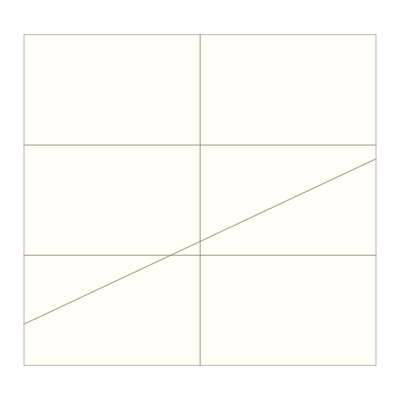 Thirds without a ruler (Haga’s theorem)
 Miura fold
 The largest equilateral triangle