Drag to rotate · Wheel / two fingers to zoom & pan
This device cannot show the 3D view. Follow the step pictures and text below instead.

1. Fold each sheet in thirds
Both sheets white side up. Fold the top third down, then fold the bottom third up over it, making a long strip.
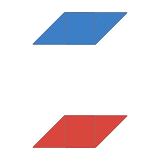
2. Fold the ends at an angle
On both strips, fold the top corner of the left end down and the bottom corner of the right end up, at 45°. Each strip becomes a slanted parallelogram.

3. Turn one strip
Turn the blue strip a quarter turn to the right so it stands upright. Do not flip it over.

4. Lay one across the other
Lay the blue strip across the red one so the centre squares of the two strips match exactly.

5. First flap: red, right
Fold the red strip’s right-hand triangle to the left over the edge of the blue strip, onto the centre.
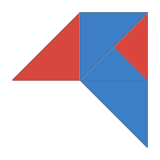
6. Second flap: blue, top
Fold the blue strip’s top triangle down onto the centre.

7. Third flap: red, left
Fold the red strip’s left triangle to the right onto the centre.

8. Tuck in the last flap
Fold the blue strip’s bottom triangle up, sliding its point under the slanted edge of the first flap (red, right). Your ddakji is done!
1. Fold each sheet in thirds
Both sheets white side up. Fold the top third down, then fold the bottom third up over it, making a long strip.
Tip:
Finished!
Well done! Watch it again or try another model.
How to play
- One player puts a ddakji on the floor. The other throws their own ddakji down hard next to it or onto it; if the one on the floor flips over, the thrower wins it.
- If it does not flip, the turn passes. Slamming down right beside it, at a slant, pushes air under it and flips it more easily.
- Bigger ddakji folded from thicker paper are harder to flip. Fold a few sizes and compare.
- Make sure nobody’s hands or face are close when you slam it down.
 Ninja star (shuriken)
 Masu box