Drag to rotate · Wheel / two fingers to zoom & pan
This device cannot show the 3D view. Follow the step pictures and text below instead.
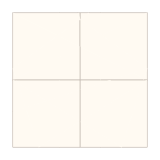
1. Two centre lines
White side up. Fold in half side to side and unfold, then bottom to top and unfold: two centre lines.
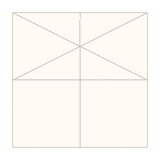
2. Two slanted creases
Crease a line from the middle of the left edge to the top-right corner, and one from the middle of the right edge to the top-left corner.
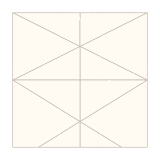
3. Find the golden points
Fold the lower half of the left edge up onto the slanted crease that starts at the middle of the left edge (the new crease starts there too), and unfold. Do the same on the right. Where the new creases meet the bottom edge are the two golden points: the pentagon’s bottom corners.
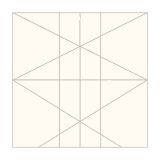
4. Two vertical creases
Fold the right part over so that the right golden point touches the vertical centre line, then unfold. Repeat on the left.
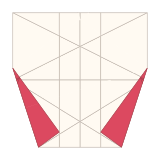
5. Fold the two lower sides
Fold the bottom-right corner up, creasing from the right golden point, so that the corner lands on the vertical crease from step 4. Fold the bottom-left corner the same way.
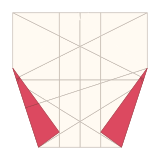
6. Find the top point
Fold the lower part up with the crease through the new corner on the right edge, so that the right golden point (the pentagon’s bottom-right corner) touches the vertical centre line. Pinch a mark there and unfold.
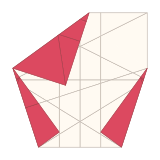
7. Fold the top left
Fold the top-left part down toward you along the line from the corner on the left edge to the top mark.

8. Fold the top right
Fold the top-right part down through all layers along the line from the top mark to the corner on the right edge.

9. Turn over: done
Turn it over: a regular pentagon with five equal sides and five equal angles.
1. Two centre lines
White side up. Fold in half side to side and unfold, then bottom to top and unfold: two centre lines.
Tip:
Finished!
Well done! Watch it again or try another model.
The maths
- A regular pentagon’s diagonal is the golden ratio (about 1.618) times its side. Here the diagonal is the full width of the paper and the side is 0.618 of it.
- The golden ratio appeared in step 3. Each slanted crease from step 2 is the diagonal of half the square, so its length involves √5; halving the angle between it and the side edge lands exactly on two points of the bottom edge 0.618 apart. The method is exact, not an approximation — any error comes only from folding.
- This same pentagon appears in T. Sundara Row’s 1893 book on geometry by paper folding.
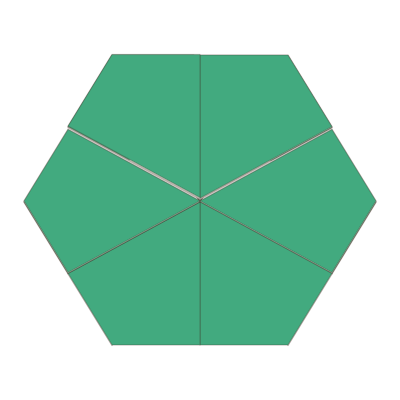 Regular hexagon
 The largest equilateral triangle
 The A4 ratio (√2)