Drag to rotate · Wheel / two fingers to zoom & pan
This device cannot show the 3D view. Follow the step pictures and text below instead.
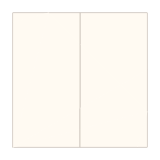
1. Crease the centre line
White side up. Fold the left edge to the right edge and unfold to make a vertical centre line.
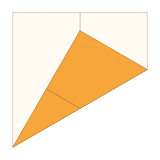
2. Corner onto the centre line (60°)
Fold the bottom-right corner up onto the centre line, with the crease starting exactly at the bottom-left corner. The folded edge now makes 60° with the bottom.
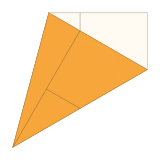
3. Halve the left angle (75°)
Fold the left edge down to lie exactly along the folded edge, again creasing from the bottom-left corner. This halves the 30° that was left.
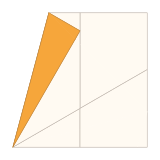
4. Unfold the bottom corner
Unfold only the bottom corner from step 2. Leave the top-left part folded.
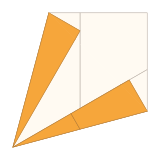
5. Halve the bottom angle (15°)
Fold the bottom edge up onto the crease from step 2, creasing from the bottom-left corner. The two new fold lines are now exactly 60° apart.
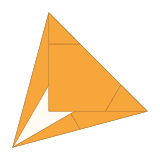
6. Fold the last corner
Fold the top-right corner down through all layers along the line joining the two points where the folds meet the top and right edges.
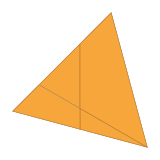
7. Turn over: done
Turn it over: the largest equilateral triangle you can fold from the square. Measure the three sides and compare!
1. Crease the centre line
White side up. Fold the left edge to the right edge and unfold to make a vertical centre line.
Tip:
Finished!
Well done! Watch it again or try another model.
The maths
- In step 2 the corner lands on the centre line, which is halfway between the two bottom corners, so the landing point is equally far from both — and it is one whole side away from the bottom-left corner. Three equal sides make an equilateral triangle, so the folded edge makes 60°.
- 90° − 60° leaves 30° on each side; halving them gives 15°. So the triangle leans 15° off each side of the square, and its sides are about 1.035 times the square’s side — bigger than a triangle standing on an edge.
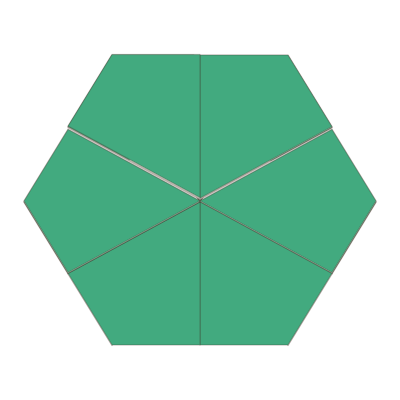 Regular hexagon
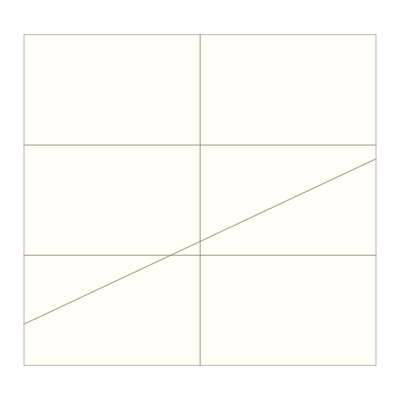 Thirds without a ruler (Haga’s theorem)
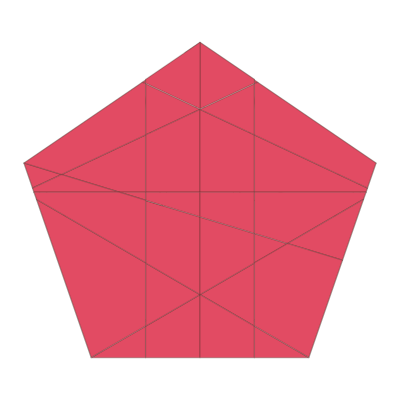 Regular pentagon (golden ratio)