Drag to rotate · Wheel / two fingers to zoom & pan
This device cannot show the 3D view. Follow the step pictures and text below instead.
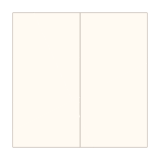
1. Crease the centre line
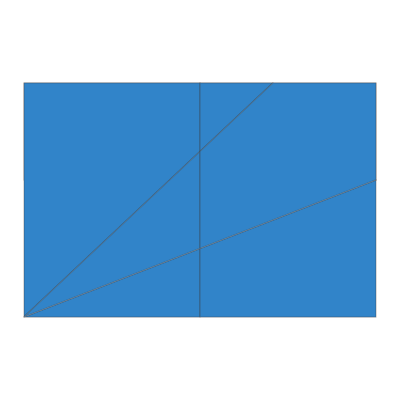
White side up. Fold the left edge to the right edge and unfold to find the middle of the top edge.
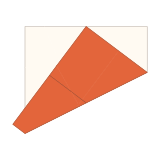
2. Find a third (Haga’s theorem)
Fold the bottom-right corner to the middle of the top edge. Where the folded bottom edge crosses the left edge is one third of the way up.
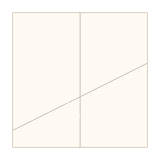
3. Mark and unfold
Pinch a small mark at that point on the left edge, then unfold.
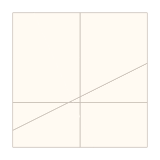
4. Lower third crease
Fold the bottom part up along a horizontal line through the mark, then unfold.
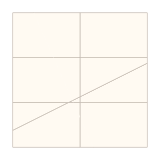
5. Upper third crease
Fold the top edge down to the lower third crease and unfold. The paper is now creased into three equal strips.
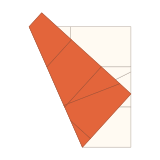
6. Two points onto two lines (Messer’s fold)
Fold the bottom-left corner over onto the right edge so that, at the same time, the left end of the lower third crease lands on the upper third crease. The point where the corner touches marks ∛2.
1. Crease the centre line
White side up. Fold the left edge to the right edge and unfold to find the middle of the top edge.
Tip:
Finished!
Well done! Watch it again or try another model.
The maths
- The corner splits the right edge into two parts: the top part is ∛2 (about 1.26) times the bottom part. A cube with the top part as its edge has exactly twice the volume of a cube with the bottom part as its edge.
- Call the part below the corner p. The second condition works out to (1 − p)³ = 2p³, so (1 − p) : p = ∛2 : 1.
- In 1837 it was proved that ruler and compass can never construct ∛2. A fold that puts two points on two lines at once can solve cubic equations, so folding can.
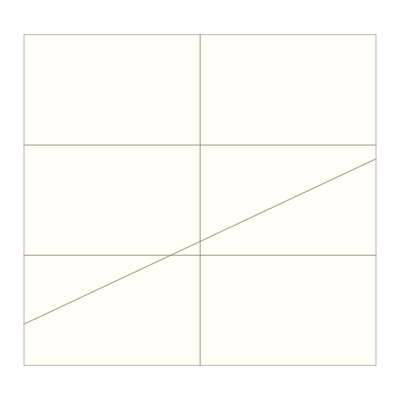 Thirds without a ruler (Haga’s theorem)
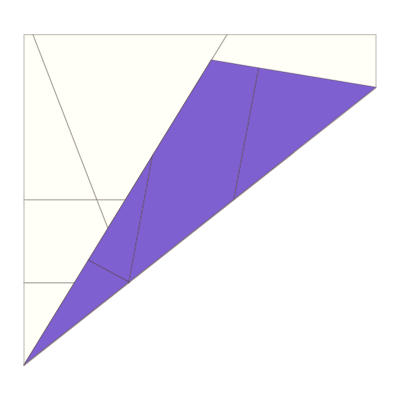 Trisecting an angle (Abe’s method)
 The A4 ratio (√2)