Drag to rotate · Wheel / two fingers to zoom & pan
This device cannot show the 3D view. Follow the step pictures and text below instead.
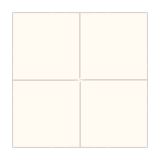
1. Two centre lines
White side up. Fold in half side to side and unfold, then bottom to top and unfold. The centre lines run from the centre to the middle of each edge.
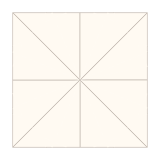
2. Two diagonals
Fold corner to opposite corner and unfold, both ways. The diagonals run from the centre to the corners.
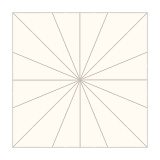
3. Halve the angles
Fold so that the right half of the horizontal centre line lies on the diagonal just above it (the crease goes through the centre), and unfold. Do the same between every centre line and the diagonal next to it: four new creases. Each time, the middles of the four edges land on the diagonals: pinch those four spots.
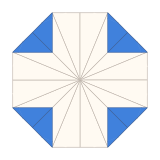
4. Fold the corners in: octagon
Fold each corner toward you on a crease through its mark, at right angles to the diagonal (the corner’s tip travels straight in along the diagonal). The outline is now a regular octagon!
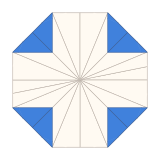
5. Halve the angles again
Fold so that the right half of the horizontal centre line lies on the crease just above it (from step 3), creasing through the centre, and unfold. Now the middle of every side meets one of the creases that run to the octagon’s corners: pinch those eight spots.
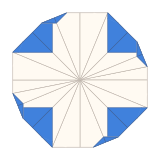
6. Fold four corners in
Take every second corner of the octagon. Fold it toward you through all layers on a crease through its mark, at right angles to the crease that runs to that corner.
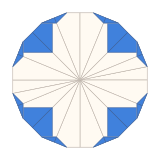
7. The other four corners
Fold the other four corners in the same way. The outline now has 16 equal sides.
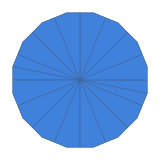
8. Turn over: done
Turn it over: a regular 16-sided polygon with all sides equal. It almost looks like a circle!
1. Two centre lines
White side up. Fold in half side to side and unfold, then bottom to top and unfold. The centre lines run from the centre to the middle of each edge.
Tip:
Finished!
Well done! Watch it again or try another model.
The maths
- Every side — new or old — is exactly half the paper’s width from the centre, so all of them touch the circle that fits inside the square. They touch it at evenly spaced points, which makes all the sides equal.
- The same two folds turn a regular pentagon into a decagon and a hexagon into a dodecagon. Try them on the pentagon from the pentagon model.
- Side lengths: the octagon’s are about 0.414 of the paper’s side, the 16-gon’s about 0.199. Keep doubling and the polygon creeps closer and closer to the circle.
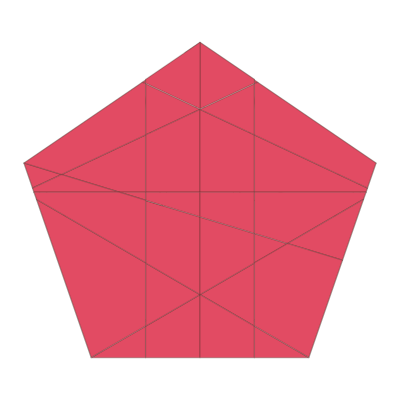 Regular pentagon (golden ratio)
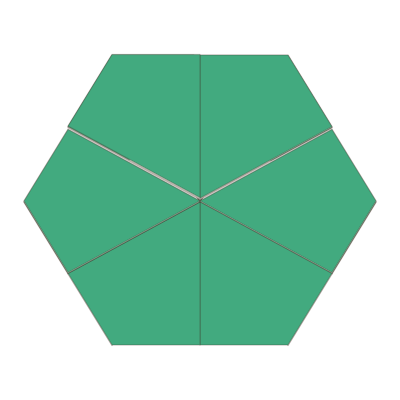 Regular hexagon
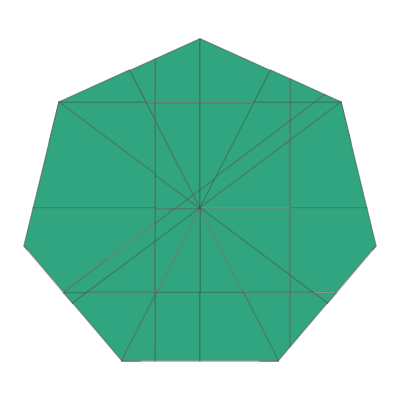 Regular heptagon (Beloch’s fold)