Skip to content
Paper Play

Geometry & modular

Doubling the sides (octagon, 16-gon)

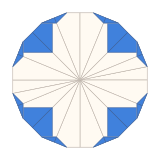
The same two folds at every corner turn a square into a regular octagon, and the octagon into a regular 16-sided polygon. Each round doubles the number of sides!

  • DifficultyIntermediate
  • PaperSquare, 15 × 15 cm
  • Steps8
  • About12 min

Why this level: The folds are easy but there are many of them; fold every corner exactly through its mark so that all sides come out equal.

You need: 1 sheet of origami paper

Preview Preview: checked on screen; real-paper verification is in progress.

Start folding

Story

Doubling the sides of a regular polygon by halving its angles is a very old idea. Around 250 BC Archimedes started from hexagons drawn inside and outside a circle and kept doubling the number of sides, up to 96, to work out the number π. Paper folders use the same idea: a handicraft book published in Buenos Aires, Argentina, in 1913 shows how to fold a decagon from a pentagon, a dodecagon from a hexagon and a 16-sided polygon from an octagon.

Did you know? With his 96-sided polygons Archimedes showed that π lies between 3.1408 and 3.1429 — more than 223/71 and less than 22/7.
Learn more (external sources)

Steps at a glance

  1. 1. Two centre lines

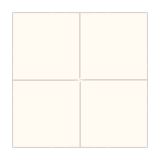
    White side up. Fold in half side to side and unfold, then bottom to top and unfold. The centre lines run from the centre to the middle of each edge.

  2. 2. Two diagonals

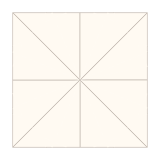
    Fold corner to opposite corner and unfold, both ways. The diagonals run from the centre to the corners.

  3. 3. Halve the angles

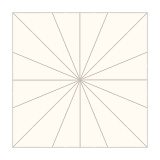
    Fold so that the right half of the horizontal centre line lies on the diagonal just above it (the crease goes through the centre), and unfold. Do the same between every centre line and the diagonal next to it: four new creases. Each time, the middles of the four edges land on the diagonals: pinch those four spots.

  4. 4. Fold the corners in: octagon

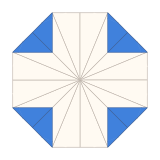
    Fold each corner toward you on a crease through its mark, at right angles to the diagonal (the corner’s tip travels straight in along the diagonal). The outline is now a regular octagon!

  5. 5. Halve the angles again

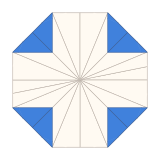
    Fold so that the right half of the horizontal centre line lies on the crease just above it (from step 3), creasing through the centre, and unfold. Now the middle of every side meets one of the creases that run to the octagon’s corners: pinch those eight spots.

  6. 6. Fold four corners in

    Take every second corner of the octagon. Fold it toward you through all layers on a crease through its mark, at right angles to the crease that runs to that corner.

  7. 7. The other four corners

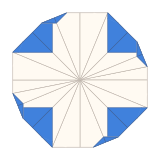
    Fold the other four corners in the same way. The outline now has 16 equal sides.

  8. 8. Turn over: done

    Turn it over: a regular 16-sided polygon with all sides equal. It almost looks like a circle!

Settings

Clear saved data