Drag to rotate · Wheel / two fingers to zoom & pan
This device cannot show the 3D view. Follow the step pictures and text below instead.
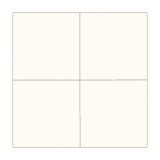
1. Two centre lines
White side up. Fold in half side to side and unfold, then bottom to top and unfold, to mark the middle of every edge.
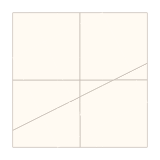
2. Find a third (Haga’s fold)
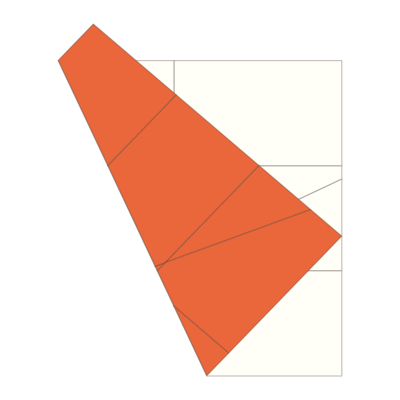
Fold the bottom-right corner to the middle of the top edge. Pinch where the folded bottom edge crosses the left edge — one third of the way up — and unfold.
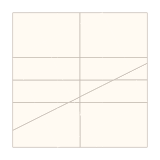
3. Thirds across
Fold the bottom part up along a level line through the mark and unfold. Fold the top edge down to that crease and unfold: three equal bands.
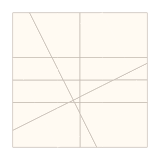
4. Another third
Now fold the bottom-left corner to the middle of the right edge. Pinch where the folded left edge crosses the top edge — one third from the left — and unfold.
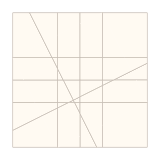
5. Thirds down
Fold the left part over along an upright line through the mark and unfold. Fold the right edge to that crease and unfold. The paper is now 9 small squares.
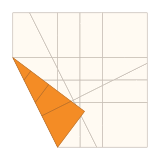
6. The first right triangle
Fold the bottom-left corner over along the line joining the upper mark on the left edge (one third down) to the left mark on the bottom edge (one third along).
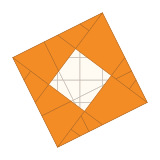
7. The other three corners
Go round the square the same way and fold the other corners. Each crease runs from the one-third mark on one edge to the one-third mark on the next. The four triangles cover the tilted square without overlapping and leave a small white square window in the middle.
1. Two centre lines
White side up. Fold in half side to side and unfold, then bottom to top and unfold, to mark the middle of every edge.
Tip:
Finished!
Well done! Watch it again or try another model.
The maths
- The creases split the paper into 9 small squares. Each folded triangle covers 1 small square’s worth, and the white window is 1 more, so the tilted square — the square on the hypotenuse — is 4 + 1 = 5 small squares.
- The square on the short leg (1 unit) is 1 small square; the square on the long leg (2 units) is 4 small squares. 1 + 4 = 5: exactly the square on the hypotenuse!
- It works for any lengths. With legs a and b and hypotenuse c: c² = 4 × (a × b ÷ 2) + (b − a)² = a² + b².
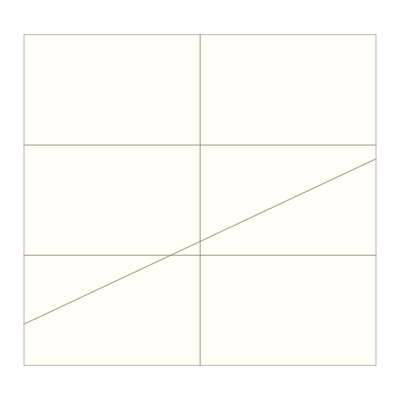 Thirds without a ruler (Haga’s theorem)
 Doubling the cube (∛2)
 The largest equilateral triangle