Drag to rotate · Wheel / two fingers to zoom & pan
This device cannot show the 3D view. Follow the step pictures and text below instead.
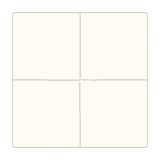
1. Two centre lines
White side up. Fold in half side to side and unfold, then bottom to top and unfold: two centre lines.
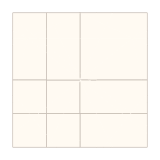
2. Two quarter creases
Fold the left edge to the vertical centre line and unfold. Fold the bottom edge to the horizontal centre line and unfold.
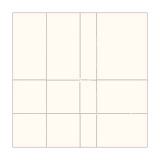
3. An eighth crease and two points
Fold the right edge to the left quarter crease and unfold. Now find two points: A, where the left quarter crease crosses the horizontal centre line, and B, where the new crease crosses the lower quarter crease.
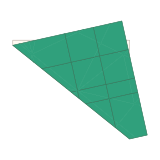
4. Two points onto two lines (Beloch’s fold)
Fold the lower-left part up so that point A lands on the vertical centre line and, at the same time, point B lands on the horizontal centre line. The crease runs from near the top of the left edge down to the right edge.
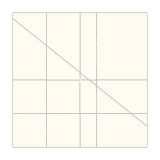
5. Mark and unfold
Pinch a mark where point A touches the vertical centre line, then unfold. This mark is the heptagon’s secret point.
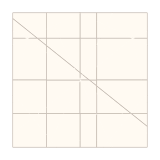
6. A horizontal crease through the mark
Fold the top part down along a horizontal line through the mark, and unfold. Keep the vertical centre line lying on itself so the crease is level.
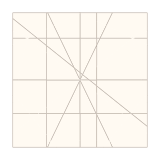
7. Find two corners
Fold along a line through the centre of the paper so that the middle of the top edge lands on the new horizontal crease, on the right. Pinch a mark there and unfold. Do the same toward the left.
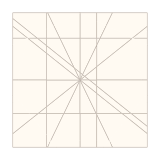
8. Find the other corners
Fold along the line through the centre and the right-hand mark. Pinch where the middle of the top edge and the left-hand mark land, and unfold. Fold along the line through the centre and the left-hand mark, pinch the two new spots and unfold. All seven corners are now marked.
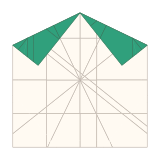
9. Fold the two top sides
Fold the top-right corner toward you along the line from the middle of the top edge to the right-hand mark. Fold the top-left corner the same way.
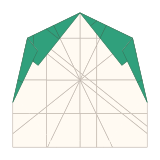
10. Fold the upper sides
Fold the right part toward you through all layers, along the line from the right-hand mark to the mark below it. Do the same on the left.
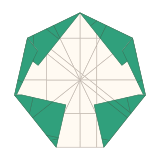
11. Fold the lower sides
Fold the lower right toward you through all layers, along the line from the mark at the right side to the lowest mark on the right. Do the same on the left.
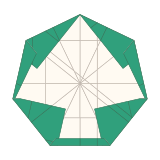
12. Fold the bottom side
Fold the bottom strip up through all layers along the level line joining the two lowest marks.
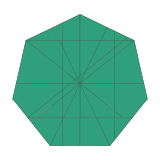
13. Turn over: done
Turn it over: a regular heptagon with seven equal sides and seven equal angles.
1. Two centre lines
White side up. Fold in half side to side and unfold, then bottom to top and unfold: two centre lines.
Tip:
Finished!
Well done! Watch it again or try another model.
The maths
- A regular heptagon needs the number r = 2 × cos(360°/7) ≈ 1.247. It solves the cubic equation z³ + z² − 2z − 1 = 0, so ruler and compass can never make it (Wantzel proved this kind of result in 1837).
- The bent path from A to B — right 1, down 1, right 2, down 1 (one unit = 1/8 of the paper) — stands for the coefficients 1, 1, −2, −1 of the equation (Lill’s method). Beloch’s fold solves it: the mark where A lands is r/4 above the centre.
- There are three folds that put both points on both lines as in step 4. With the other two, A lands exactly at the heights of the other two pairs of heptagon corners: the three answers of the equation are the three rows of corners.
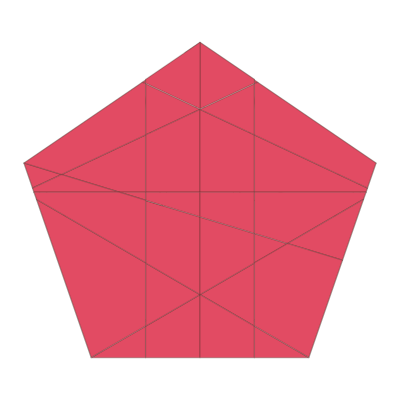 Regular pentagon (golden ratio)
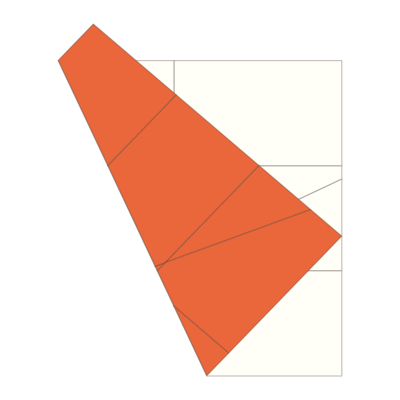 Doubling the cube (∛2)
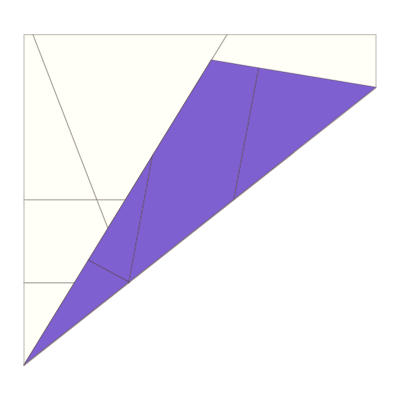 Trisecting an angle (Abe’s method)