Skip to content
Paper Play

Geometry & modular

Regular heptagon (Beloch’s fold)

Ruler and compass can never draw a regular heptagon. One fold that puts two points onto two lines at once finds its secret point — then fold an exact seven-sided shape.

  • DifficultyChallenging
  • PaperSquare, 15 × 15 cm
  • Steps13
  • About20 min

Why this level: Many guide creases, one fold that brings two points onto two lines at the same time, two point-onto-line folds, and seven sides folded in turn.

You need: 1 sheet of origami paper

Preview Preview: checked on screen; real-paper verification is in progress.

Start folding

Story

A regular heptagon cannot be drawn exactly with ruler and compass: its corners depend on the number 2 × cos(360°/7), which is the answer to a cubic equation. For a long time people used approximations; Heron of Alexandria gave one about 2000 years ago. In 1867 the Austrian engineer Eduard Lill found a way to solve cubic equations by drawing them as a bent path, and in 1936 the Italian mathematician Margherita Beloch showed that a fold putting two points onto two lines at once solves them. That fold is step 4.

Did you know? The British 50p and 20p coins are heptagons with gently curved sides. The curves make the coin equally wide in every direction, so coin machines that check a coin’s size can still accept it.
Learn more (external sources)

Steps at a glance

  1. 1. Two centre lines

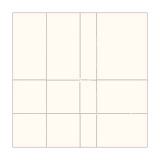
    White side up. Fold in half side to side and unfold, then bottom to top and unfold: two centre lines.

  2. 2. Two quarter creases

    Fold the left edge to the vertical centre line and unfold. Fold the bottom edge to the horizontal centre line and unfold.

  3. 3. An eighth crease and two points

    Fold the right edge to the left quarter crease and unfold. Now find two points: A, where the left quarter crease crosses the horizontal centre line, and B, where the new crease crosses the lower quarter crease.

  4. 4. Two points onto two lines (Beloch’s fold)

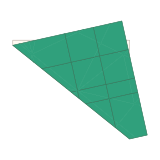
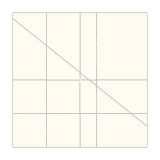
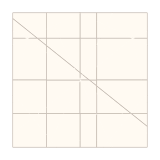
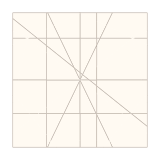
    Fold the lower-left part up so that point A lands on the vertical centre line and, at the same time, point B lands on the horizontal centre line. The crease runs from near the top of the left edge down to the right edge.

  5. 5. Mark and unfold

    Pinch a mark where point A touches the vertical centre line, then unfold. This mark is the heptagon’s secret point.

  6. 6. A horizontal crease through the mark

    Fold the top part down along a horizontal line through the mark, and unfold. Keep the vertical centre line lying on itself so the crease is level.

  7. 7. Find two corners

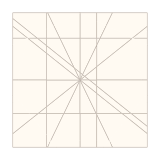
    Fold along a line through the centre of the paper so that the middle of the top edge lands on the new horizontal crease, on the right. Pinch a mark there and unfold. Do the same toward the left.

  8. 8. Find the other corners

    Fold along the line through the centre and the right-hand mark. Pinch where the middle of the top edge and the left-hand mark land, and unfold. Fold along the line through the centre and the left-hand mark, pinch the two new spots and unfold. All seven corners are now marked.

  9. 9. Fold the two top sides

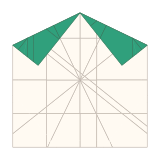
    Fold the top-right corner toward you along the line from the middle of the top edge to the right-hand mark. Fold the top-left corner the same way.

  10. 10. Fold the upper sides

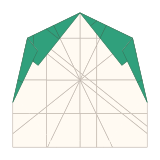
    Fold the right part toward you through all layers, along the line from the right-hand mark to the mark below it. Do the same on the left.

  11. 11. Fold the lower sides

    Fold the lower right toward you through all layers, along the line from the mark at the right side to the lowest mark on the right. Do the same on the left.

  12. 12. Fold the bottom side

    Fold the bottom strip up through all layers along the level line joining the two lowest marks.

  13. 13. Turn over: done

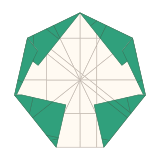
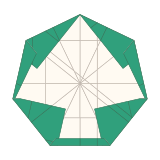
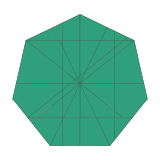
    Turn it over: a regular heptagon with seven equal sides and seven equal angles.

Settings

Clear saved data