Skip to content
Paper Play

Geometry & modular

Trisecting an angle (Abe’s method)

Something ruler and compass cannot do: split 60° into three exact 20° angles by folding.

  • DifficultyIntermediate
  • PaperSquare, 15 × 15 cm
  • Steps7
  • About8 min

Why this level: One fold brings two points onto two lines at the same time; slide the paper gently until both fit.

You need: 1 sheet of origami paper

Preview Preview: checked on screen; real-paper verification is in progress.

Start folding

Story

Since ancient Greece, mathematicians tried to split any angle into three equal parts using only a ruler and compass. In 1837 Pierre Wantzel proved that this cannot be done in general — not even for 60°. Paper folding is more powerful: this method, with its fold that puts two points onto two lines at once, was reported in 1980 and is due to Hisashi Abe in Japan.

Did you know? Splitting an angle into two equal parts is easy with ruler and compass — only splitting it into three is impossible in general.
Learn more (external sources)

Steps at a glance

  1. 1. Two evenly spaced creases

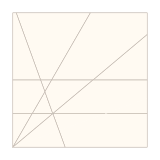
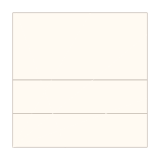
    White side up. Fold the bottom edge to the top edge and unfold; then fold the bottom edge to that middle crease and unfold.

  2. 2. Make a 60° angle

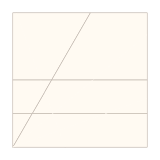
    Fold the top-left corner down onto the middle crease, with the crease starting at the bottom-left corner, then unfold. The crease makes 60° with the bottom edge: this is the angle we will trisect.

  3. 3. Two points onto two lines (Abe’s fold)

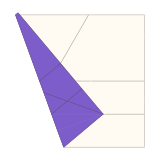
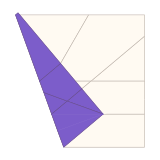
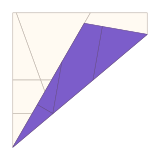
    Fold the lower-left part over so that the bottom-left corner lands on the quarter crease and, at the same time, the left end of the middle crease lands on the 60° crease.

  4. 4. Crease along the folded quarter line

    Crease through all layers along the quarter crease on the folded flap, then unfold just this crease (keep Abe’s fold). Extended, this line runs exactly through the tip of the angle, where the corner used to be.

  5. 5. Unfold and extend the crease

    Unfold Abe’s fold. Fold along the new crease again, extending it all the way to the bottom-left corner, and unfold. This is the first trisecting line (40°).

  6. 6. Bottom edge onto the 40° crease (20°)

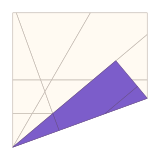
    Fold the bottom edge up to lie exactly on the 40° crease, creasing from the bottom-left corner. This fold is the second trisecting line (20°).

  7. 7. Fold once more to check

    Fold all layers up along the 40° crease. The folded edge lands exactly on the 60° crease: the 60° angle is split into three equal 20° parts!

Settings

Clear saved data